
Reader's Place: February 2026
National Book Award winning author Imani Perry will be visiting the library on February 27 to help us celebrate Black History Month; in anticipation of her visit, check out one of her books or selected others exploring Black history in America.
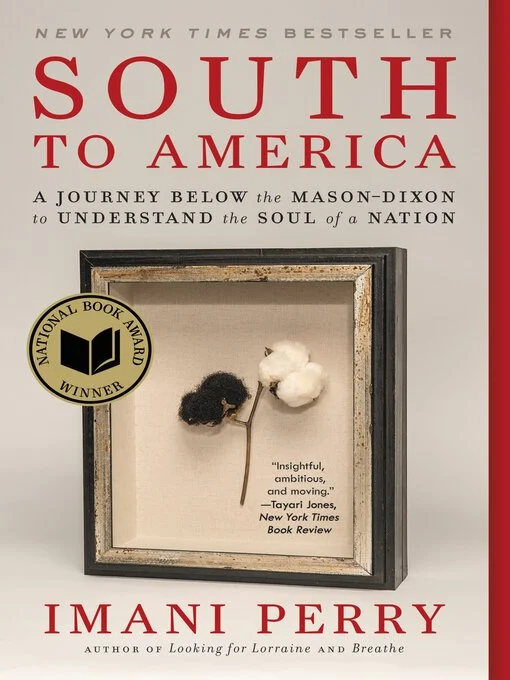
South to America: a journey below the Mason-Dixon to understand the soul of a nation, by Imani Perry (Library Catalog, Hoopla)
An essential, surprising journey through the history, rituals, and landscapes of the American South—and a revelatory argument for why you must understand the South in order to understand America. We all think we know the South. Even those who have never lived there can rattle off a list of signifiers: the Civil War, Gone with the Wind, the Ku Klux Klan, plantations, football, Jim Crow, slavery. But the idiosyncrasies, dispositions, and habits of the region are stranger and more complex than much of the country tends to acknowledge. In South to America, Imani Perry shows that the meaning of American is inextricably linked with the South, and that our understanding of its history and culture is the key to understanding the nation as a whole. This is the story of a Black woman and native Alabaman returning to the region she has always called home and considering it with fresh eyes. Her journey is full of detours, deep dives, and surprising encounters with places and people. She renders Southerners from all walks of life with sensitivity and honesty, sharing her thoughts about a troubling history and the ritual humiliations and joys that characterize so much of Southern life. Weaving together stories of immigrant communities, contemporary artists, exploitative opportunists, enslaved peoples, unsung heroes, her own ancestors, and her lived experiences, Imani Perry crafts a tapestry unlike any other. With uncommon insight and clarity, South to America offers an assertion that if we want to build a more humane future for the United States, we must center our concern below the Mason-Dixon Line.
The 1619 Project: a New Origin Story, edited by Nikole Hannah-Jones (Library Catalog)
A dramatic expansion of a groundbreaking work of journalism, The 1619 Project: A New Origin Story offers a profoundly revealing vision of the American past and present. In late August 1619, a ship arrived in the British colony of Virginia bearing a cargo of twenty to thirty people stolen from Africa. Their arrival led to the barbaric and unprecedented system of American chattel slavery that would last for the next 250 years. The New York Times Magazine’s award-winning 1619 Project issue reframed our understanding of American history by placing slavery and its continuing legacy at the center of our national narrative. This book substantially expands on that work, weaving together eighteen essays that explore the legacy of slavery in present-day America with thirty-six poems and works of fiction that illuminate key moments of oppression, struggle, and resistance. The essays show how the inheritance of 1619 reaches into every part of contemporary American society, from politics, music, diet, traffic, and citizenship to capitalism, religion, and our democracy itself. This book speaks directly to our current moment, contextualizing the systems of race and caste within which we operate today. It reveals long-glossed-over truths around our nation’s founding and construction—and the way that the legacy of slavery did not end with emancipation, but continues to shape contemporary American life.
Four Hundred Souls: a Community History of African America, 1619-2019, edited by Ibram X. Kendi and Keisha N. Blain (Library Catalog)
The story begins in 1619 when the White Lion disgorges “some 20-and-odd Negroes” onto the shores of Virginia, inaugurating the African presence in what would become the United States. It takes us to the present, when African Americans, descendants of those on the White Lion and a thousand other routes to this country, continue a journey defined by inhuman oppression, visionary struggles, stunning achievements, and millions of ordinary lives passing through extraordinary history. Four Hundred Souls is a unique one-volume “community” history of African Americans. The editors assembled ninety brilliant writers, each of whom takes on a five-year period of that four-hundred-year span. The writers explore their periods through a variety of techniques: historical essays, short stories, personal vignettes, and fiery polemics. They approach history from various perspectives: through the eyes of towering historical icons or the untold stories of ordinary people; through places, laws, and objects. While themes of resistance and struggle, of hope and reinvention, course through the book, this collection of diverse pieces from ninety different minds, reflecting ninety different perspectives, fundamentally deconstructs the idea that Africans in America are a monolith—instead it unlocks the startling range of experiences and ideas that have always existed within the community of Blackness.
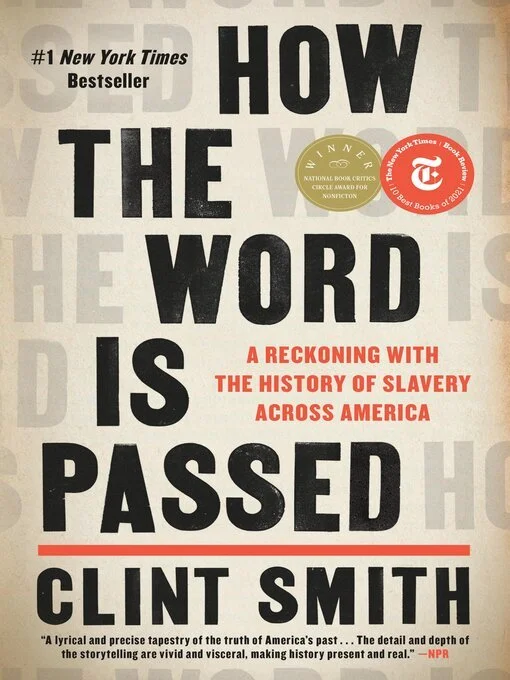
How the Word Is Passed: a Reckoning with the History of Slavery Across America, by Clint Smith (Library Catalog)
This important and timely narrative examines the legacy of slavery in America—and how both history and memory continue to shape our everyday lives.Beginning in his hometown of New Orleans, Clint Smith leads the reader on an unforgettable tour of monuments and landmarks—those that are honest about the past and those that are not—that offer an intergenerational story of how slavery has been central in shaping our nation's collective history, and ourselves. It is the story of the Monticello Plantation in Virginia, the estate where Thomas Jefferson wrote letters espousing the urgent need for liberty while enslaving more than four hundred people. It is the story of the Whitney Plantation, one of the only former plantations devoted to preserving the experience of the enslaved people whose lives and work sustained it. It is the story of Angola, a former plantation-turned-maximum-security prison in Louisiana that is filled with Black men who work across the 18,000-acre land for virtually no pay. And it is the story of Blandford Cemetery, the final resting place of tens of thousands of Confederate soldiers.
A deeply researched and transporting exploration of the legacy of slavery and its imprint on centuries of American history, How the Word Is Passed illustrates how some of our country's most essential stories are hidden in plain view—whether in places we might drive by on our way to work, holidays such as Juneteenth, or entire neighborhoods like downtown Manhattan, where the brutal history of the trade in enslaved men, women, and children has been deeply imprinted.
Informed by scholarship and brought to life by the story of people living today, Smith's debut work of nonfiction is a landmark of reflection and insight that offers a new understanding of the hopeful role that memory and history can play in making sense of our country and how it has come to be.
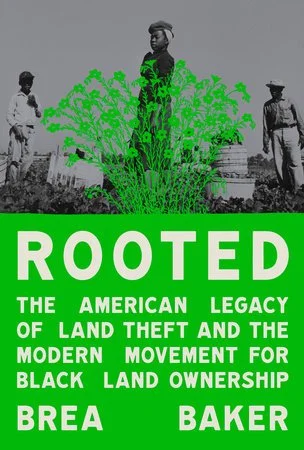
Rooted: the American Legacy of Land Theft and the Modern Movement for Black Land Ownership, by Brea Baker (Library Catalog)
Why is less than 1% of rural land in the U.S. owned by Black people? Bakerexplores the impact of land theft and violent displacement on racial wealth gaps, arguing that justice stems from the literal roots of the earth. To understand the contemporary racial wealth gap, we must first unpack the historic attacks on Indigenous and Black land ownership. Research suggests that between 1910 and 1997, Black Americans lost about 90% of their farmland. Land theft widened the racial wealth gap, privatized natural resources, and created a permanent barrier to access that should be a birthright for Black and Indigenous communities. Rooted traces the experiences of Brea Baker’s family history of devastating land loss in Kentucky and North Carolina, identifying such violence as the root of persistent inequality in this country. Ultimately, her grandparents’ commitment to Black land ownership resulted in the Bakers Acres—a haven for the family where they are sustained by the land, surrounded by love, and wholly free. A testament to the Black farmers who dreamed of feeding, housing, and tending to their communities, Rooted bears witness to their commitment to freedom and reciprocal care for the land. By returning equity to a dispossessed people, we can heal both the land and our nation’s soul.
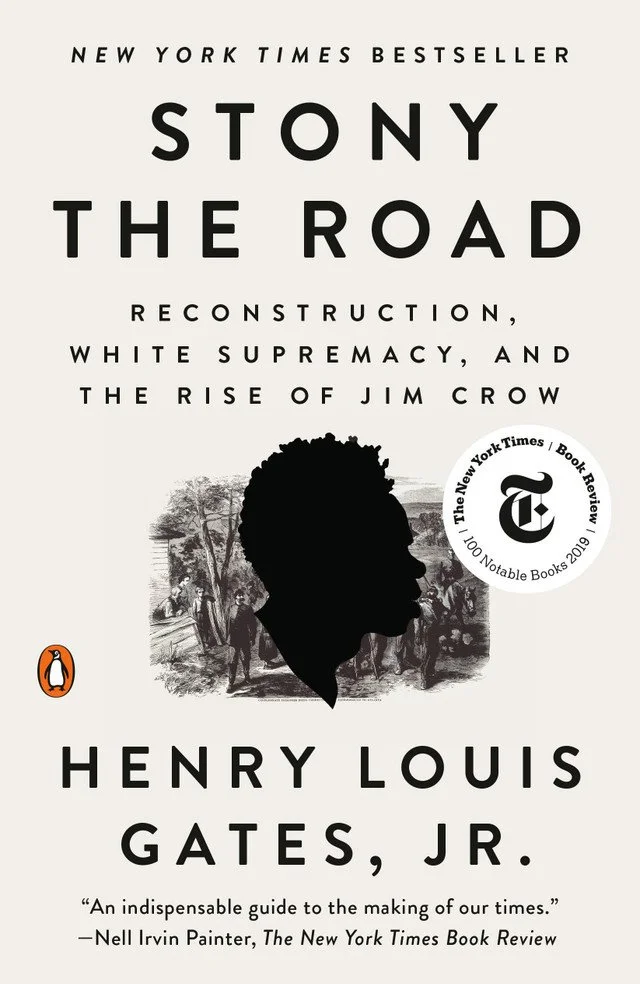
Stony the Road: Reconstruction, White Supremacy, and the Rise of Jim Crow, by Henry Louis Gates, Jr. (Library Catalog)
A profound rendering of the struggle by African Americans for equality after the Civil War and the violent counter-revolution that resubjugated them, as seen through the prism of the war of images and ideas that have left an enduring racist stain on the American mind. The abolition of slavery in the aftermath of the Civil War is a familiar story, as is the civil rights revolution that transformed the nation after World War II. But the century in between remains a mystery: if emancipation sparked "a new birth of freedom" in Lincoln's America, why was it necessary to march in Martin Luther King, Jr.'s America? Henry Louis Gates, Jr. seeks to answer that question in a history that moves from the Reconstruction Era to the "nadir" of the African-American experience under Jim Crow, through to World War I and the Harlem Renaissance. An essential tour through one of America's fundamental historical tragedies, Stony the Road is also a story of heroic resistance, as figures such as W. E. B. Du Bois and Ida B. Wells fought to create a counter-narrative, and culture, inside the lion's mouth. As sobering as this tale is, it also has within it the inspiration that comes with encountering the hopes our ancestors advanced against the longest odds.
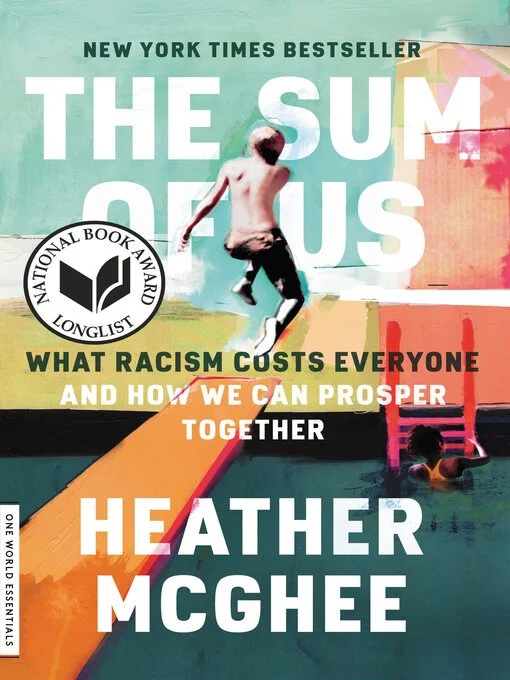
The Sum of Us: What Racism Costs Everyone and How We Can Prosper Together, by Heather McGhee (Library Catalog)
Heather McGhee’s specialty is the American economy—and the mystery of why it so often fails the American public. From the financial crisis of 2008 to rising student debt to collapsing public infrastructure, she found a root problem: racism in our politics and policymaking. But not just in the most obvious indignities for people of color. Racism has costs for white people, too. It is the common denominator of our most vexing public problems, the core dysfunction of our democracy and constitutive of the spiritual and moral crises that grip us all. But how did this happen? And is there a way out? McGhee embarks on a deeply personal journey across the country from Maine to Mississippi to California, tallying what we lose when we buy into the zero-sum paradigm—the idea that progress for some of us must come at the expense of others. Along the way, she meets white people who confide in her about losing their homes, their dreams, and their shot at better jobs to the toxic mix of American racism and greed. This is the story of how public goods in this country—from parks and pools to functioning schools—have become private luxuries; of how unions collapsed, wages stagnated, and inequality increased; and of how this country, unique among the world’s advanced economies, has thwarted universal healthcare. But in unlikely places of worship and work, McGhee finds proof of what she calls the Solidarity Dividend: the benefits we gain when people come together across race to accomplish what we simply can’t do on our own. The Sum of Us is not only a brilliant analysis of how we arrived here but also a heartfelt message, delivered with startling empathy, from a black woman to a multiracial America. It leaves us with a new vision for a future in which we finally realize that life can be more than a zero-sum game.
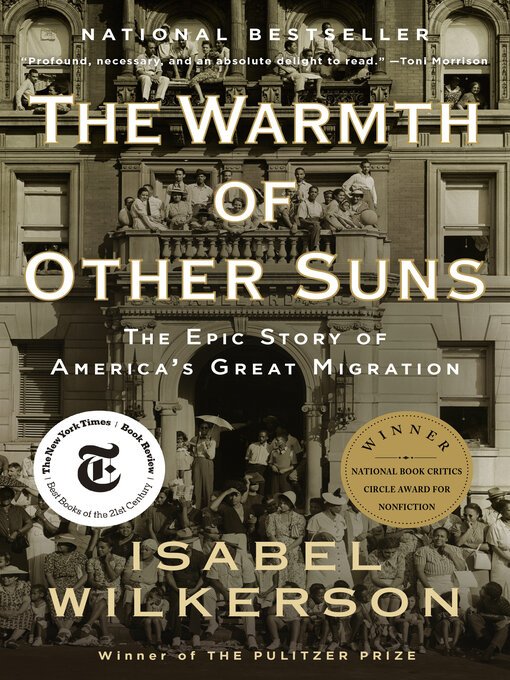
The Warmth of Other Suns: the Epic Story of America's Great Migration, by Isabel Wilkerson (Library Catalog)
Isabel Wilkerson presents a definitive and dramatic account of one of the great untold stories of American history: the Great Migration of six million Black citizens who fled the South for the North and West in search of a better life, from World War I to 1970. Wilkerson tells this interwoven story through the lives of three unforgettable protagonists: Ida Mae Gladney, a sharecropper’s wife, who in 1937 fled Mississippi for Chicago; sharp and quick-tempered George Starling, who in 1945 fled Florida for Harlem, and Robert Foster, a surgeon who left Louisiana in 1953 in hopes of making it in California. Wilkerson brilliantly captures their first treacherous cross-country journeys by car and train and their new lives in colonies in the New World. The Warmth of Other Suns is a bold, remarkable, and riveting work, a superb account of an “unrecognized immigration” within our own land.
Compiled by Jenny Zbrizher.